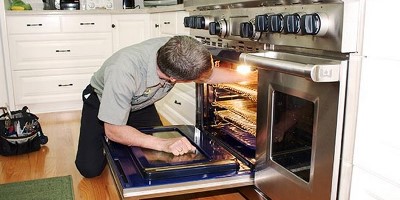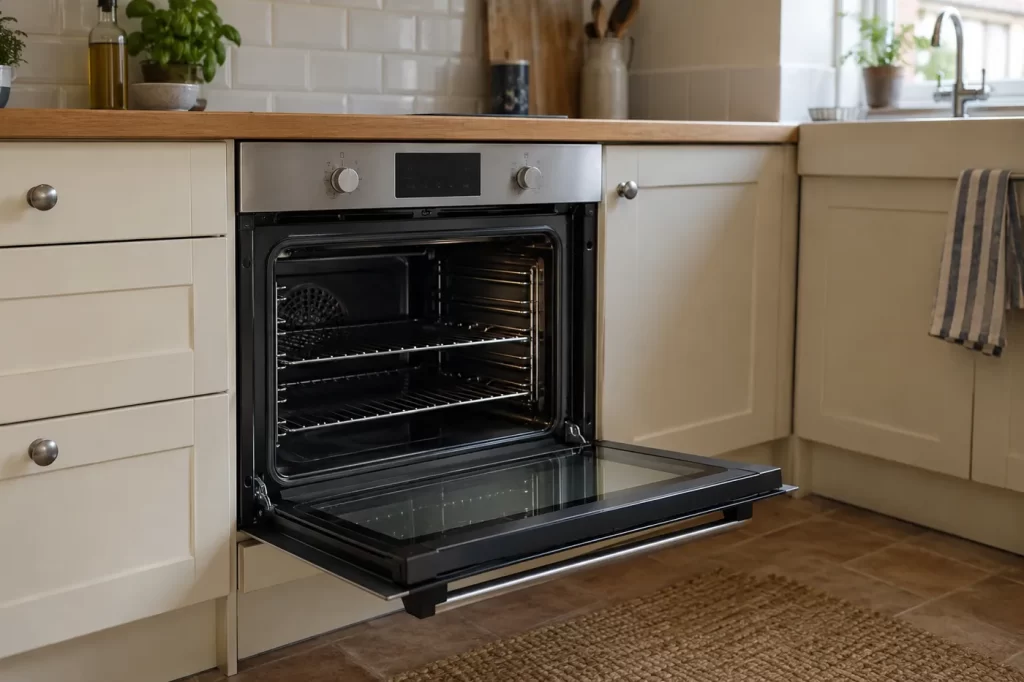
The inside of an oven is not one uniform surface. Enamel, special liners, glass, seals and fittings can have different cleaning instructions. Before reaching for a spray or scraper, identify the appliance and the part you want to clean. That decision matters more than the strength of the product.
The safest starting point is the manual for the exact model, a cooled appliance and a product explicitly suitable for the surface being treated. Do not put ordinary oven cleaner on special liners, force apart a glass door or assume a cleaning programme permits every accessory to stay inside. If there is damage, an electrical fault or uncertainty about a component, pause and ask the manufacturer or an appropriate engineer. Cleaning does not repair an appliance.
Mistake: treating every oven as the same appliance
Find the make and model number before choosing a cleaning method. The information may be on the appliance’s rating plate; check the manufacturer’s guidance for its location. Download the correct manual rather than a manual for an oven that looks similar. Take account of separate oven cavities, grills and steam functions. A range cooker may have several compartments with different instructions.
Bosch’s UK oven support provides a route to model-specific advice and manuals. Use the equivalent support for your own brand. Keep the manual available to anyone cleaning the appliance. When arranging professional oven cleaning, give the model, number of cavities and any known liner or door issues. The team cannot sensibly confirm every removable component from the external width alone.
Mistake: spraying special liners with a general cleaner
Some ovens use catalytic surfaces or other special coatings. They may look like a textured panel and have cleaning requirements that differ from the smooth cavity floor. Check the manual; do not identify the material by touch alone. The surrounding surfaces may still need conventional care, but that does not mean the same treatment is suitable for every panel.
AEG’s catalytic cleaning instructions warn against putting detergents, oven sprays or abrasives on catalytic liners. The programme and preparation depend on the model. Read your own instructions before running it, and accept that a remaining discolouration is not necessarily removable soil. Scrubbing until a panel changes colour can damage it rather than improve its cleaning ability.
Do not try to remove a liner unless the manual describes it as user-removable and gives the method. Screws can secure parts that are not intended for ordinary household cleaning. Keep unfamiliar fittings intact and explain the concern when seeking advice. If a previous cleaner or household member has already applied a product, say what it was and which areas were treated.

Mistake: assuming the label only concerns the waiting time
Read the whole product label before use. It may restrict the appliances, materials, protective equipment and application method, as well as specifying a contact time. Check the exclusions as carefully as the promised results. A product marketed for ovens may still be unsuitable for a self-cleaning model, aluminium fittings or a particular surface. Stronger is not a useful selection rule.
Use only one suitable product as directed. Do not add bleach, acids, another cleaner or a homemade mixture to improve the result. Keep the container and its label so the instructions are available if there is a problem. Ventilate and use the stated protection. Keep children and pets away from the work, and do not decant chemicals into an unlabelled food or drink container.
Apply the product where the instructions permit it, without flooding gaps, controls or vents. A cloth or sponge still needs to be suitable for the finish. If the residue does not respond within the permitted method, stop and reassess instead of adding longer soaking, extra chemicals and harder tools together. It becomes difficult to work out which treatment has caused a change.
Mistake: cleaning before the oven has cooled
Finish cooking and let the appliance cool as instructed before manual cleaning. Do not rush because warm residue looks easier to shift. Hot metal, glass and accessories can cause injuries, and a cleaner may not be intended for a heated surface. Follow the appliance instructions about switching off or isolating it for the particular task. Do not interfere with electrical connections or gas fittings.
AEG’s cleaning and care guidance specifies a cool oven and distinguishes different cleaning functions. That is a reminder to establish the actual process rather than improvise a heating cycle to dry a chemical. If a cleaning product requires a particular rinsing or finishing step, follow that step instead of assuming that switching the oven on will remove any remaining residue.
Mistake: running a cleaning programme without preparing it
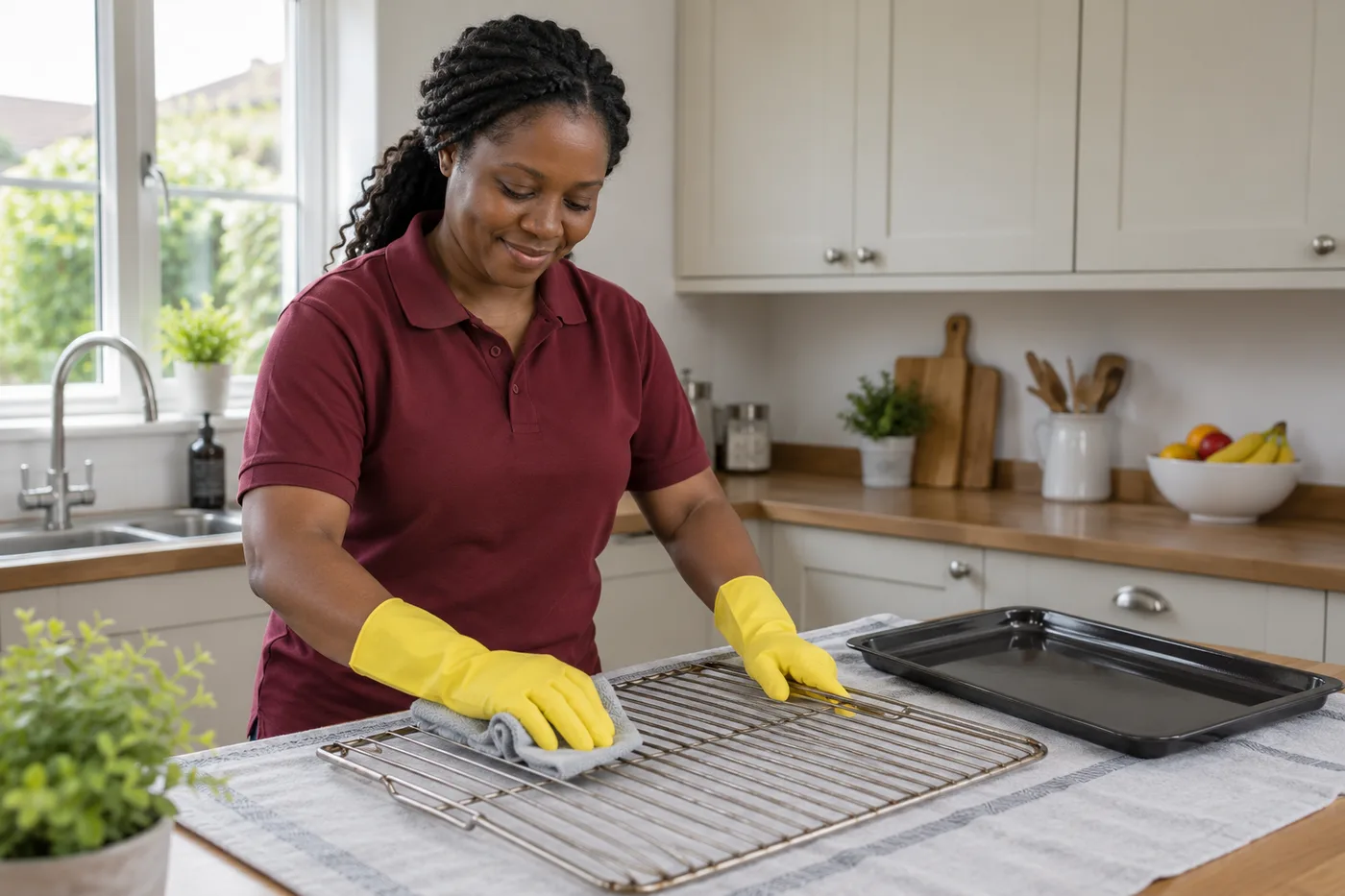
Pyrolytic, catalytic and steam-assisted functions are different systems. Check which one your appliance has and follow the preparation instructions for that function. Accessories, shelves and supports may need to be removed, but the permitted arrangement is model-specific. Do not put pans or unrelated objects into the oven simply because the programme seems like a convenient way to clean them.
Read the instructions before starting, including any restrictions on residue, ventilation, locking and cooling. A door that remains locked during the prescribed cycle should not be forced. An unfamiliar error message belongs in the troubleshooting instructions, not in a cleaning experiment. Refer to the manufacturer’s information, such as AEG’s overview of its cleaning systems, then confirm the steps in your own model manual.
Plan the task when you can follow the instructions without needing the oven immediately afterwards. Allow the required cooling and finishing time. If a programme has failed, or the appliance smells unusual in a way the manual does not explain, seek support before repeating it. A cleaning service should be told about recent cycles and faults before attending.
Mistake: forcing the door apart to reach a mark
Glass doors can contain several panels and different fixings. Some models provide a user-removal procedure; others require servicing. Check the exact instructions and do not borrow the method from another brand. A mark between panels does not justify levering an edge with a knife or screwdriver. Damaged glass or a loose assembly can make further handling unsafe.
Use the approved cleaning method on accessible glass. Do not use abrasive pads or scrapers unless the appliance guidance explicitly allows a suitable tool. Protect the door from knocks and avoid resting heavy items on it. If removal is permitted, prepare the supported working area and reassembly instructions before starting. Stop if the fixing does not release as described rather than applying more force.
Mistake: soaking seals and fittings indiscriminately
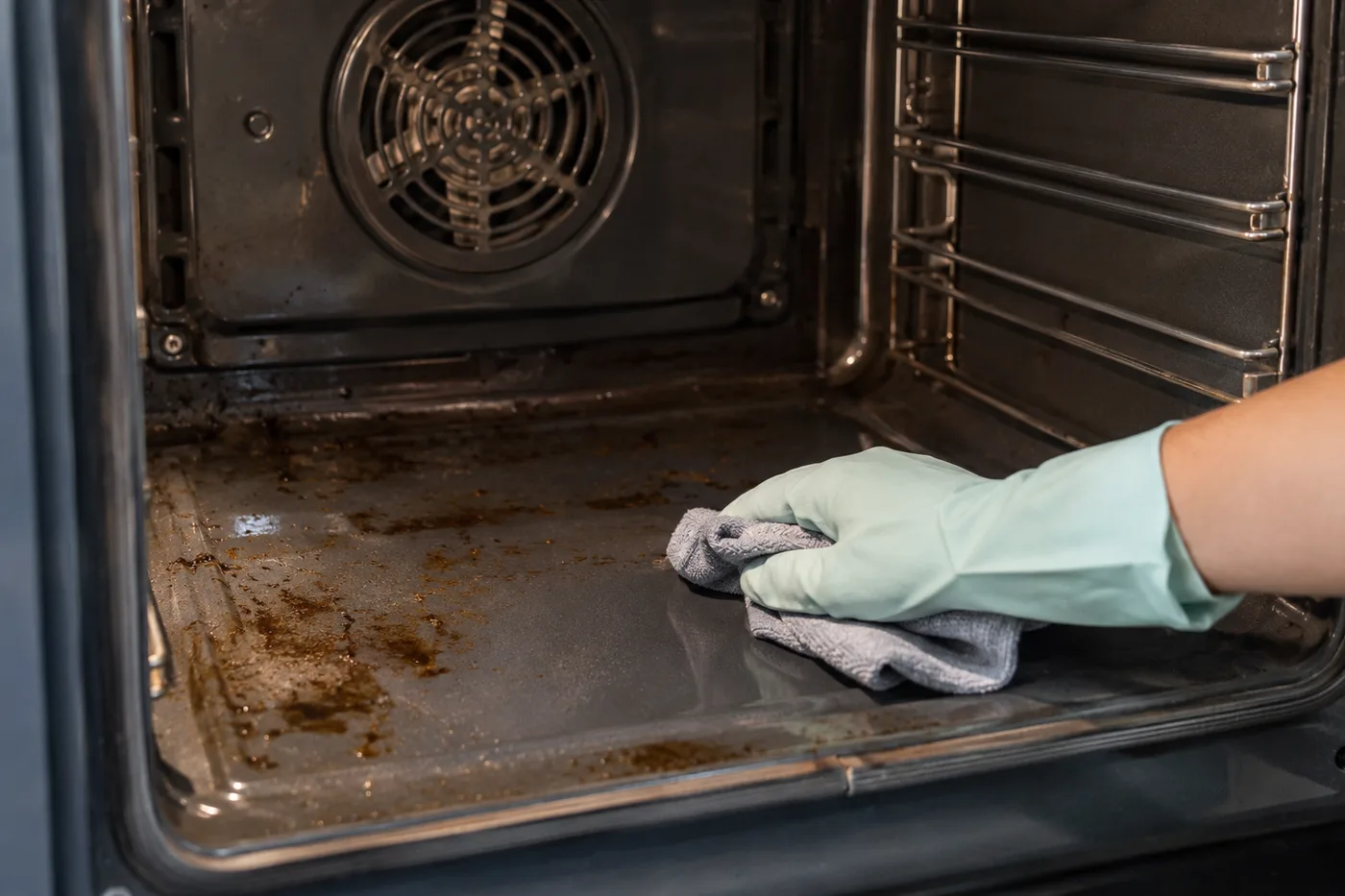
The door seal, hinges, light cover and surrounding fittings have their own purpose. They are not simply obstacles to a clean-looking cavity. Follow the manual about whether and how they may be cleaned. Do not pull a seal out, poke around the fan housing or flood a fitting because residue is visible nearby. A damaged seal or fitting should be assessed as a fault.
Describe any damaged, detached or brittle-looking part to the manufacturer or engineer. Photograph it without dismantling the appliance. When requesting a quote, distinguish cleaning of accessible surfaces from repair or replacement. A cleaner removing grease should not be expected to diagnose every operating problem or certify the appliance as safe.
Mistake: treating every rack and tray as bare metal
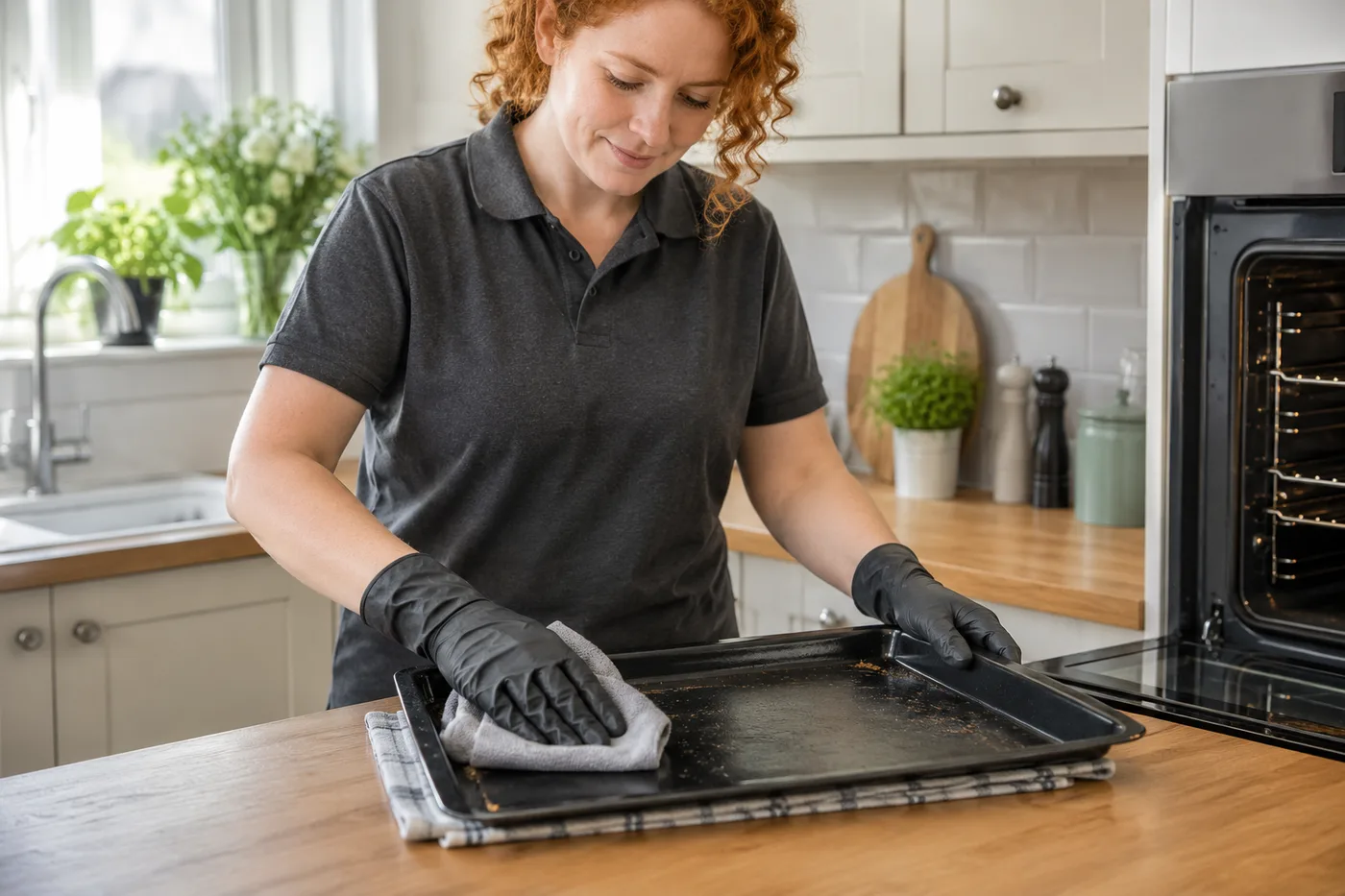
Accessories can have coatings and care restrictions too. Find out which items belong to the appliance and whether they are suitable for soaking, dishwashing or a particular cleaner. Keep original and extra trays separate when describing a booking. A coated baking tray should not be assumed to tolerate the same treatment as an uncoated rack.
Use a suitable container and protect surrounding kitchen surfaces if the permitted method involves soaking. Avoid leaving chemicals where someone can mistake the solution for washing-up water. Rinse or finish as instructed, then return only the appropriate dry components. If a coating is peeling or a tray is damaged, cleaning cannot put that coating back.
Mistake: judging readiness by the absence of a smell
Follow the product and appliance instructions for removing residue, rinsing and returning the oven to use. A surface that looks clean is not proof that the finishing steps have been completed. Equally, a persistent problem should not be dismissed because a general online timetable has elapsed. Our existing article on using an oven after cleaning covers that separate question; the specific instructions still take priority.
Check that the appropriate components are back in their intended positions before cooking. If you have lost a part or are unsure about reassembly, do not improvise. Keep the cleaning product details and any photographs of the original arrangement. Ask the person who carried out the clean which surfaces were treated, what could not be reached and what finishing steps are required.
A short decision table before you start
| What you have found | Useful next step | Avoid |
|---|---|---|
| Unknown liner or textured panel | Identify the model and check the liner instructions | Testing a strong oven spray on it |
| Mark between glass panels | Check whether the door has an approved user-removal process | Forcing a panel or borrowing another model’s method |
| Heavy residue on an accessible surface | Choose an explicitly compatible method or request assessment | Stacking products, longer soaking and abrasives |
| Error, damaged seal or loose fitting | Contact the appropriate support or engineer | Calling it a cleaning problem without checking |
Choose the right kind of help for the job
When asking for a quote, count the cooking compartments and describe which parts need attention. A double oven, a separate grill and a range cooker can involve different work. Tell the cleaner if a panel is loose, a seal is torn or the door does not close properly. Mention any product already applied and whether a cleaning programme has recently run. Keep the model details available for the appointment. This lets you agree the scope and flag a repair concern before someone arrives with equipment intended for a straightforward cleaning visit.
An oven appointment makes sense when the agreed cleaning is beyond the time or equipment you can reasonably manage. Provide the appliance details and explain the residue rather than asking for a guaranteed original finish. Include any hob, extractor or separate grill request in the scope. Those items should not be assumed to form part of a quote for one oven cavity.
If grease has also collected across the wider kitchen, discuss a one-off kitchen clean as a separate requirement. For the smaller jobs between appointments, regular household cleaning may be appropriate. The between-visit kitchen routine helps keep those jobs manageable without treating a quick daily wipe as appliance maintenance.
Keep the manufacturer’s instructions as the reference point throughout. You do not need a special trick for every mark. You need to know the material, use a permitted process and recognise when cleaning should stop. That prevents a stubborn patch of food becoming a scratched panel, a damaged coating or an avoidable repair.