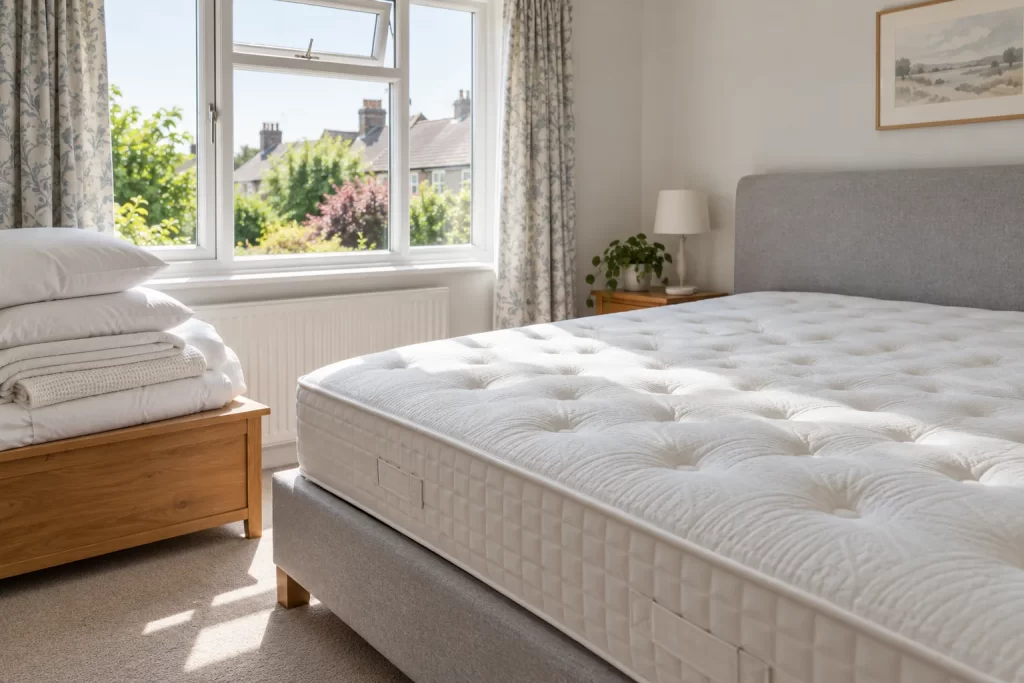
To refresh a mattress safely, start with its care label and the maker’s instructions. Strip the bedding, let the mattress air in a ventilated room and remove loose surface dust only by the method the manufacturer permits. Some covers may be brushed, some may be vacuumed gently, and others are removable and washable; those methods are not interchangeable. For a small fresh spill, blot immediately with a dry absorbent cloth and follow the model’s stain instructions. Do not saturate the cover or core. Keep sheets and protector off until every treated area is fully dry.
The phrase “deep clean a mattress” can make a bucket of solution or a steam machine sound useful. In many mattresses, however, liquid can travel past the cover into layers that are slow to dry. TEMPUR UK’s care guidance says its foam material cannot be washed, sponged or dry-cleaned and warns that soaking can cause irreversible damage. Hypnos’s care guide tells owners to use a soft brush rather than a vacuum on its upholstery and to blot spills with dry towels. The correct routine is therefore product-specific and mostly dry.
Check the label before touching the sleep surface
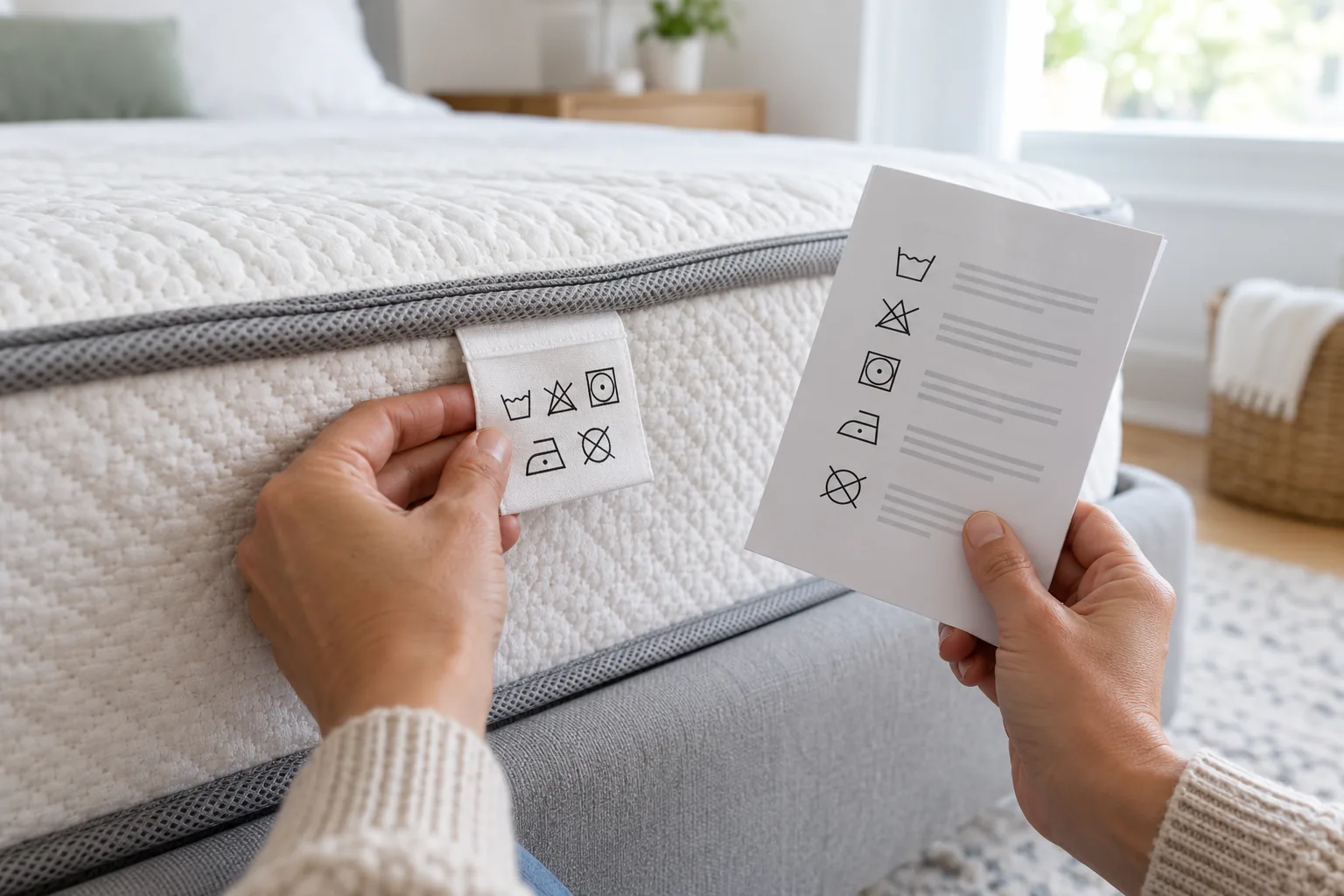
Look for a label sewn to the mattress or inside a removable cover, and find the exact model’s care instructions online if necessary. Note whether the mattress has a separate cover, a washable top panel, a quilted foam layer or a fixed fabric surface. A zip does not automatically mean the cover may be machine washed. TEMPUR notes that some removable covers with foam in them are for airing only. Check the washing temperature, drying method and reassembly instructions if a cover can be removed. Photograph the label so you can refer to it during cleaning.
Do not assume the whole mattress may be flipped or rotated as part of a refresh. Some are single-sided and must not be turned. Heavy mattresses can also be awkward to move. Follow the maker’s handling directions and get help rather than bending the mattress or lifting it by handles that were not designed to carry its full weight. If the model’s instructions are missing, contact the maker before applying any water or product to an uncertain material.
Start with the bed base too. A mattress needs the ventilation arrangement specified by its manufacturer. TEMPUR says its mattresses should sit on a ventilated base to avoid moisture accumulation. Hypnos recommends a breathable protector and warns against non-breathable plastic sheeting that can trap condensation. The right base and cover are part of keeping the mattress fresh; a surface clean alone will not overcome persistent trapped moisture underneath.
Air the bed and remove dry surface debris
Open the room to suitable airflow and pull the duvet and sheets back. This gives everyday moisture a chance to dissipate. Hypnos recommends leaving bed linen turned back for a few hours as part of its care routine. Follow your own model’s guidance and avoid adding moisture from a nearby laundry rack.
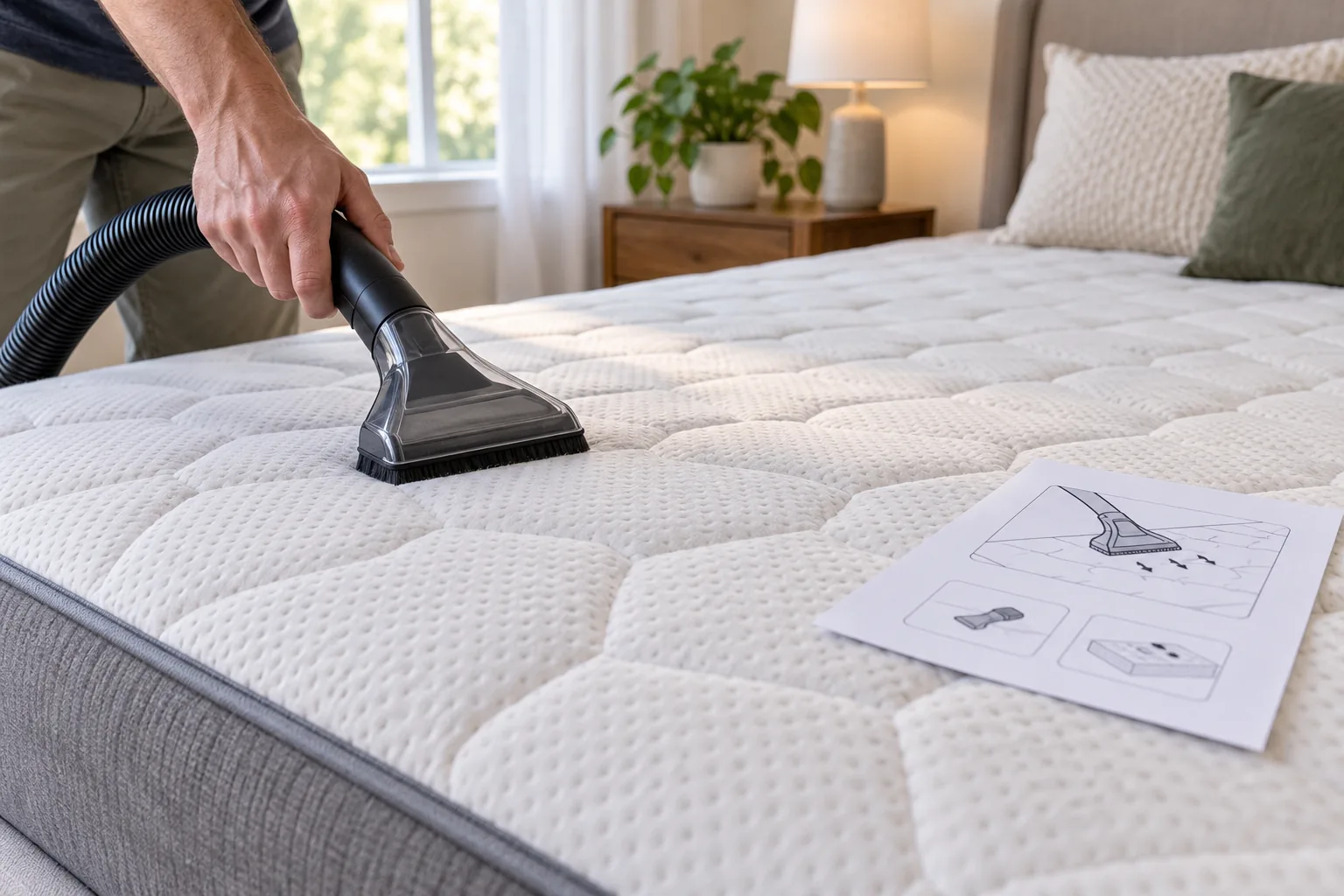
Remove hair and loose particles from the surface using the approved method. If the maker permits vacuuming, use a clean upholstery attachment with light suction and smooth, overlapping passes. Keep the nozzle on the cover rather than tugging at seams or pulling loose threads. But do not treat vacuuming as universal: Hypnos says a vacuum can disturb its upholstery fillings, and TEMPUR’s instructions do not recommend vacuuming its textile covers. A soft brush may be the right choice for those products. Collect loosened dust without beating the mattress or shaking debris through the room.
Pay attention to seams and the edges where bedding gathers, but do not use a hard crevice nozzle that could snag the fabric. Check the base and slats for dry dust while the mattress is uncovered. If you see evidence of pests, widespread mould or damp, stop the routine and seek appropriate specialist advice. A normal surface refresh is not a substitute for resolving an infestation or a moisture problem.
Respond to a small spill before it reaches the core
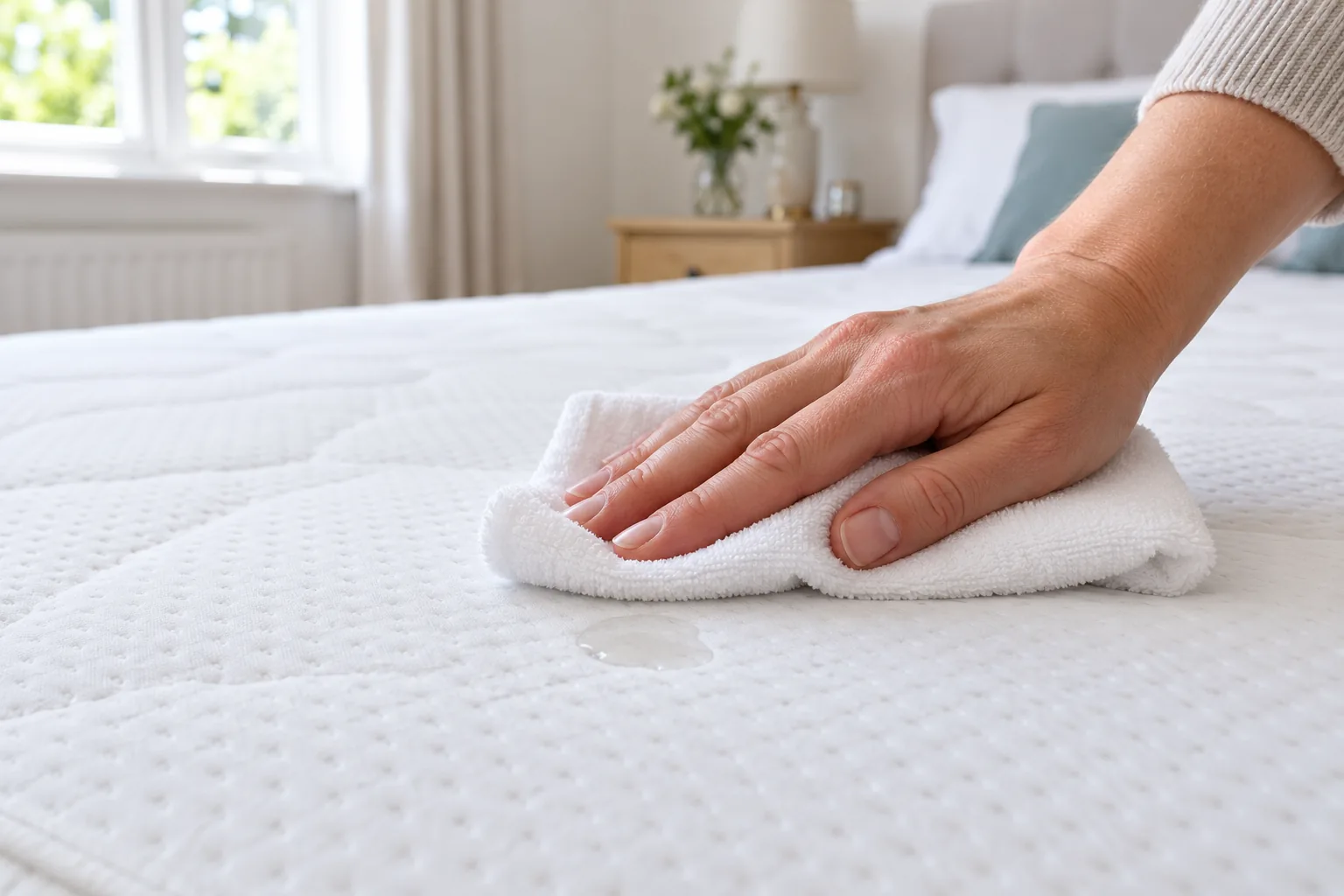
Move bedding away and blot a fresh spill with dry towels or kitchen paper. Press gently, lift, and use a clean part of the towel on the next pass. Do not rub the liquid across a larger area or push it deeper into the mattress. Hypnos specifically recommends immediate treatment with dry towels or paper towels and warns that detergents may damage its fabric. TEMPUR advises soaking up as much as possible with towels if liquid reaches its material or a non-washable cover.
After blotting, check the exact care guidance for what, if anything, may be applied next. Some models may permit careful surface treatment with a barely damp cloth; others prohibit it. A stain-removal recipe from a sofa or carpet cannot simply be transferred to a mattress. Do not pour water, detergent, vinegar or deodoriser into the fabric. Even when the top looks dry, moisture may remain within the cover or foam. Avoid using heat from a hairdryer or placing bedding back early unless the maker specifically approves the method.
If a removable cover is washable, follow its label for the wash cycle and drying. Keep the mattress core protected while the cover is off, and replace the cover only when it is thoroughly dry. Refit it in the correct orientation; some products have a specific top side. If the spill was large enough to soak into the core, the mattress smells damp or you cannot dry it fully, contact the manufacturer or a qualified specialist for advice. Do not promise that a household surface clean can make a saturated mattress hygienic again.
Avoid shortcuts that add moisture or hide odours
Steam, extraction machines and large amounts of liquid can wet layers well below a visible mark. TEMPUR forbids steam-cleaning its foam material, while other mattress makers have different rules. Follow the exact product rather than assuming a method is safe because it is marketed as “mattress cleaning”. A professional service should also know the mattress construction and care limits before wet work is proposed.
Powdered deodoriser or bicarbonate may leave residue in fabric or seams and will not resolve the source of a damp smell. Use powder only if the maker allows it and an approved removal method exists. Airing, clean bedding, a suitable protector and prompt spill response are more dependable everyday measures.
Do not spray disinfectant or fragrance heavily across the sleep surface. Apart from compatibility with the cover, a treated surface must be safe and completely dry before a person lies on it. If a stain, smell or damp patch persists, seek model-specific advice instead of repeating stronger applications. A mattress that has been extensively contaminated may need specialist assessment or replacement; the answer depends on its construction and the contamination, not on a generic home remedy.
Remake the bed only when everything is dry
After any permitted surface cleaning or cover wash, check the mattress with a clean dry hand and cloth in more than one place. Feel along seams and the spill area, not just the centre of the panel. If you can detect cool dampness or a lingering wet smell, leave the bed uncovered and continue airing according to the maker’s guidance. Do not trap the moisture under a waterproof protector and fitted sheet. A dry, well-ventilated base supports the process.
Launder sheets and the protector according to their labels while the mattress airs. A protector is a practical barrier against later spills, but choose one compatible with the mattress and its ventilation requirements. Hypnos recommends a breathable protector; TEMPUR also points owners towards a protector to limit moisture reaching the foam. Check the fit and avoid layers that bunch or hold liquid against the surface.
Make a simple care rhythm: air the bed regularly, wash bedding as appropriate, inspect the mattress for a small spill before it sets and use only the manufacturer’s approved dust-removal method. For broader planning, see our room-by-room deep-cleaning frequency guide. One-off deep cleaning may help with accessible bedroom surfaces, while mattress treatment must respect its specific construction and care label.
Common questions
Should every mattress be vacuumed?
No. Some manufacturers permit a gentle upholstery attachment, while Hypnos advises a soft brush and TEMPUR does not recommend vacuuming its textile covers. Read your model’s instructions before choosing a method.
Can I steam-clean a mattress to freshen it?
Only if its maker expressly permits that method and you can meet the drying requirements. TEMPUR says its foam material must not be steam-cleaned. A general steam-cleaning tip is not safe for every mattress.
When can I put the bedding back after a spill?
Wait until the cover and any treated surface are fully dry, including seams and the spill area. Follow the manufacturer’s drying directions. If moisture has reached the core or a damp smell persists, seek specialist or manufacturer advice before using it again.